
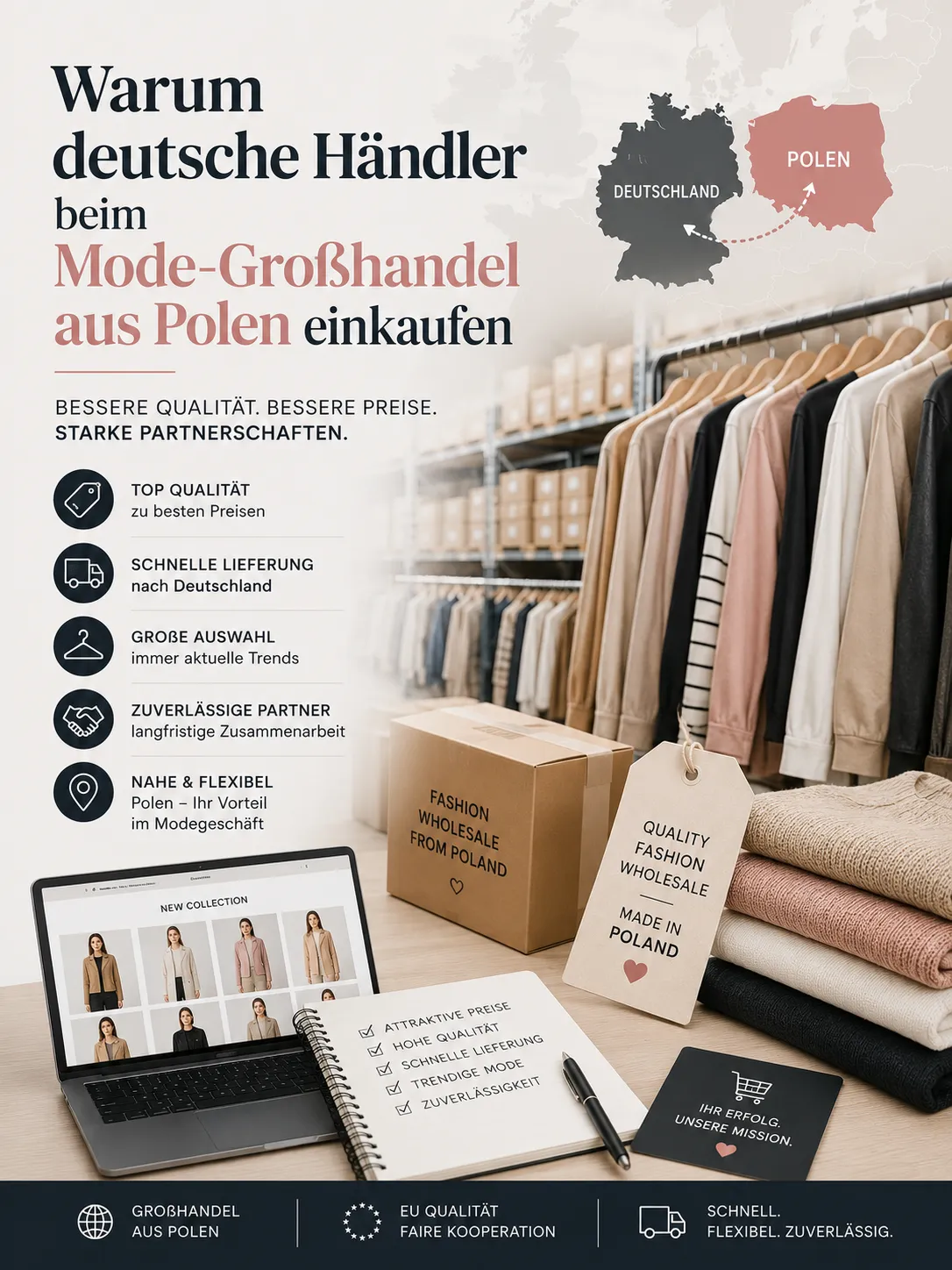
Wholesale Fashion from Poland: Why European Retailers Are Choosing Polish Suppliers
More boutiques and online fashion stores across Europe are sourcing women’s clothing from Poland – and there are practical business reasons behind this shift. While direct imports from Asia and other non-EU markets involve customs procedures, longer lead times and increasing regulatory requirements, sourcing from a Polish fashion wholesaler combines EU market access, short delivery times and competitive wholesale prices. This guide explains the main benefits for European retailers – from customs and VAT to logistics, product testing and returns.
Poland as a Fashion Sourcing Hub: More Than Competitive Prices
Poland has developed into an important textile, clothing and distribution hub within the European Union. Around established fashion centres such as Łódź, a broad network of manufacturers, clothing companies, importers and wholesalers supplies retailers across Europe. For international buyers, the main advantage is not simply lower prices.
The strength of sourcing from Poland lies in the combination of price, speed and proximity to the European market. Polish fashion suppliers operate within the EU market and can respond much faster to changing demand than suppliers located thousands of kilometres away.
Wholesalers such as FactoryPrice combine products sourced from several manufacturing markets, including Poland, Italy and Turkey, with distribution from Poland. This gives European boutiques and online stores access to a broad range of women’s fashion through a single wholesale platform.
For retailers, this model provides another important advantage: instead of building inventory around a few large seasonal orders, they can replenish stock more frequently and adjust their assortment according to actual sales.
The EU Advantage: No Customs Duties on Intra-EU Trade
One of the most important advantages for EU retailers buying from Poland is straightforward: Poland is part of the European Union and the EU Single Market.
For a retailer located in another EU member state, purchasing goods from a Polish wholesaler is fundamentally different from importing clothing directly from a non-EU country.
What Direct Imports from Non-EU Countries Can Involve
When clothing is imported directly into the European Union from a third country, the buyer may become responsible for a number of import procedures and obligations, depending on the origin of the goods and applicable customs arrangements:
- Customs declarations and EORI registration: commercial imports into the EU generally require customs clearance and an EORI number.
- Customs duties: depending on the product classification and country of origin, customs duties may apply to imported clothing.
- Import VAT: import VAT may need to be accounted for as part of the import process according to the rules applicable in the destination country.
- Product compliance: importers may have additional responsibilities concerning textile labelling, product safety and applicable EU regulations.
- Longer supply chains: international freight, customs clearance and potential delays make replenishment less predictable.
What Changes When You Buy from Poland?
For businesses located within the EU, purchasing from a Polish wholesaler takes place within the EU Single Market. In practice, this can substantially simplify the sourcing process.
- no customs duties between EU member states,
- no standard import customs clearance for intra-EU movement of goods,
- no international container freight required for individual orders,
- shorter and more predictable delivery routes,
- transactions conducted within the common EU regulatory framework.
For a boutique or online store, the key benefit is predictability. It becomes easier to calculate the real cost of purchasing stock and significantly easier to replenish products during the season.
Fast European Delivery Instead of Waiting Weeks for Stock
Speed is particularly important in fashion retail. A product that sells strongly today may lose demand within several weeks. Long sourcing cycles therefore increase both inventory risk and the amount of capital tied up in stock.
Poland’s central European location provides a significant logistical advantage. Orders can be shipped through established European parcel and courier networks to multiple EU markets without the long transit times associated with intercontinental sourcing.
Depending on the destination country and selected carrier, delivery to many European markets can take only a few working days. FactoryPrice processes orders quickly, allowing retailers to use the wholesaler not only for seasonal purchasing but also for regular stock replenishment.
What Does Faster Replenishment Mean for a Fashion Retailer?
- Order according to actual demand: start with smaller quantities and reorder products that are selling.
- React to trends faster: introduce new styles without waiting for the next major seasonal order.
- Reduce inventory risk: shorter replenishment cycles reduce the need to hold large quantities of stock.
- Improve cash flow: less capital needs to remain tied up in slow-moving inventory.
- Refresh the store more frequently: regular new arrivals give customers a reason to return.
Intra-EU VAT: How B2B Purchases from Poland Work
VAT is one of the most common questions when retailers start buying wholesale clothing from another EU country.
For qualifying transactions between VAT-registered businesses located in different EU member states, the transaction can generally be treated as an intra-Community supply of goods, subject to the applicable EU and national VAT requirements.
In practical terms, the process typically works as follows:
- The buyer registers with the wholesaler using a valid EU VAT identification number.
- The VAT number is verified, normally through the EU VIES system.
- When the legal requirements for an intra-Community supply are satisfied, the Polish supplier may issue the invoice without Polish VAT.
- The buyer accounts for the intra-Community acquisition according to the VAT rules applicable in the destination member state.
For VAT-registered retailers, this means that purchasing from Poland does not normally require paying Polish VAT and subsequently applying for its reimbursement.
VAT treatment depends on the status of the buyer, destination of the goods and individual transaction. Businesses should confirm their specific VAT obligations with their accountant or tax adviser.
Low-Quantity Purchasing Reduces Inventory Risk
One of the largest risks for independent fashion retailers is not the purchase price itself. It is buying too much of the wrong product.
Traditional wholesale models often require retailers to purchase complete packs, size runs or minimum quantities. That can work for proven bestsellers, but it creates unnecessary risk when testing new styles.
FactoryPrice allows registered business customers to purchase products in small quantities, including from one piece per model where available. This changes how a boutique can build its assortment.
Instead of purchasing large quantities before knowing what customers want, retailers can test different:
- dress styles,
- blouses and tops,
- matching sets,
- knitwear,
- trousers,
- jackets and coats,
- seasonal fashion.
Products that sell can then be reordered while stock remains available. Products that do not perform well do not leave the retailer with a large quantity of unsold inventory.
Returns and Product Testing
Quality is another important consideration when choosing a new wholesale clothing supplier. Ordering from a supplier within Europe makes product testing and communication considerably easier than dealing with an anonymous overseas source.
First: test products in small quantities. Where products are available for single-piece purchasing, retailers can check fabric, construction, fit and overall quality before committing to larger quantities.
Second: check the wholesaler’s B2B return conditions before ordering. FactoryPrice provides return procedures for eligible orders according to its current terms and conditions. Because B2B return rights are not the same as statutory consumer withdrawal rights, professional buyers should always check the applicable conditions before placing an order.
Third: work with a supplier operating within the European market. Communication, shipping and claims are handled within a much shorter supply chain, which can simplify day-to-day purchasing for retailers.
Who Can Benefit from a Polish Women’s Clothing Wholesaler?
Sourcing wholesale fashion from Poland can be particularly useful for businesses that need a broad assortment and regular access to new products without committing large amounts of capital to every style.
This includes:
- independent fashion boutiques,
- online women’s clothing stores,
- marketplace sellers,
- social commerce sellers,
- multi-brand fashion stores,
- retailers looking for an additional European clothing supplier.
The model is especially relevant to smaller and medium-sized retailers that compete through assortment and speed rather than through purchasing huge quantities of individual products.
Wholesale Clothing from Poland vs Direct Overseas Import
The right sourcing model depends on the retailer’s scale and business model. Large-volume direct manufacturing in Asia can still make commercial sense when a retailer orders thousands of identical units and can plan collections months in advance.
For independent boutiques and online stores, however, European wholesale sourcing offers a different set of advantages:
- smaller purchasing quantities,
- shorter delivery times,
- faster stock replenishment,
- lower inventory exposure,
- no customs duties on intra-EU trade,
- simpler sourcing within the EU Single Market.
The relevant question is therefore not simply: “Where can I buy clothing at the lowest unit price?”
For a retailer, the more useful question is: “Which supplier gives me the best combination of purchase price, delivery speed, assortment flexibility and inventory risk?”
Frequently Asked Questions
Are there customs duties when buying wholesale clothing from Poland?
If both the supplier and the buyer are located within the European Union and the goods move between EU member states, there are generally no customs duties on the intra-EU movement of those goods. Poland is part of the EU Single Market.
Can an EU business buy from a Polish wholesaler without Polish VAT?
For qualifying intra-Community B2B transactions, a Polish supplier may invoice without Polish VAT when the relevant requirements are satisfied, including a valid EU VAT identification number. The buyer then accounts for the acquisition according to the VAT rules of its own country.
How long does delivery from Poland to other European countries take?
Delivery time depends on the destination and carrier. Poland’s central location allows shipments to many EU countries to arrive within a few working days, making Polish wholesalers suitable for regular stock replenishment as well as planned purchasing.
Can I test wholesale clothing before ordering larger quantities?
FactoryPrice offers many products in small quantities, including single-piece purchasing where available. This allows retailers to test styles, materials, fit and customer demand before increasing order quantities.
Who can buy wholesale women’s clothing from FactoryPrice?
FactoryPrice supplies online stores, independent boutiques, marketplace sellers and other fashion retailers looking for women’s clothing for resale. The current registration and purchasing conditions are available directly on the wholesale platform.
Is Poland a good source of wholesale clothing for European boutiques?
For many boutiques, Poland offers a useful combination of EU-based sourcing, competitive wholesale pricing, broad product selection and relatively short delivery routes. This makes it particularly suitable for retailers that prefer frequent replenishment and smaller purchasing quantities.
Conclusion: A European Supply Chain Built for Faster Fashion Retail
Buying wholesale women’s clothing from Poland gives European retailers an alternative to both domestic wholesalers and long-distance direct imports. The main advantage is not based on price alone. It comes from combining competitive purchasing conditions with short supply routes, flexible order quantities and access to a broad assortment within the EU market.
For boutiques and online stores, this can translate into faster replenishment, less capital tied up in stock and greater freedom to test products before committing to larger quantities.
Create a wholesale account with FactoryPrice and browse the current selection of wholesale women’s clothing available for retailers across Europe.